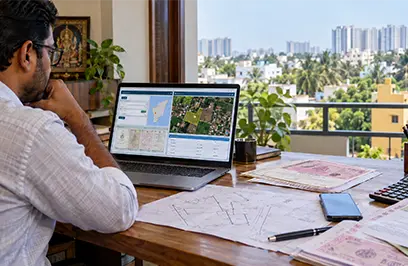
For every smart investor, understanding the patta document while buying land in Tamil Nadu is non-negotiable. This record of revenue is the government’s recognition of your lawful possession and is the backbone of secure property ownership. So, if you are planning to buy the upcoming corridors or want to buy plots in Chennai, then knowing how to verify and secure your patta will save your investment from legal issues. In this guide we will go over the complete process of patta check and application. Meaning of patta and types and online procedure included.
A land patta is a revenue document issued by the Tamil Nadu Revenue Department through the office of the Tahsildar, which establishes the person recognized by the government as the rightful owner of a particular piece of land.
Think of it this way, your sale deed of registration shows you bought the property, but the patta shows you as the current owner (known as the “pattadar”) in the government revenue records. If you don’t have a patta in your name, it can be a challenge to get building permits, bank loans or government schemes related to land ownership.
In Tamil, patta means “ownership record” and contains important information such as survey number, subdivision number, extent of land, land classification (wetland or dryland) and tax assessment details.
The patta document has several important purposes for landowners in Tamil Nadu:
The first thing that you need to do if you are looking to buy a piece of land in Paruthipattu is to make sure that the patta is clear and transferable.
Patta in Tamil Nadu is classified based on the use of land and irrigation status. It is good to understand these categories when you are reviewing documents for plots in GST road or other locations:
| Type | Description | Typical Use |
|---|---|---|
| Wetland Patta (Nanjai) | Granted for irrigated agricultural land. Irrigated agricultural land is normally cultivated for paddy and near water sources like tanks, canals or wells. | Agricultural purposes |
| Dryland Patta (Punjai) | Assigned to non-irrigated land, often converted for residential or commercial development. | Residential plots, commercial use |
| Special Patta | Granted under specific government schemes or for particular purposes such as housing board allocations or welfare programs. | Scheme-based allocations |
While searching for plots in Chennai, most of the residential layouts will be on dryland patta, as the land has been converted from agricultural to residential.
The important details in a normal patta extract are:
Cross verify these details against your sale deed and encumbrance certificate before finalizing any deal on plots in Tambaram or plots in Paruthipattu.
Tamil Nadu government’s e-Services portal makes patta check easy and accessible from anywhere. Here is the step by step procedure to check patta online:
This land patta check process is very useful when you are evaluating plots in GST road or plots in Avadi Chennai and want to confirm the ownership before you make the commitment.
If you have bought a land recently and wish to transfer the patta in your name, you can apply for patta chitta online through Tamil Nadu e-Services or TamilNilam portal. Below is the complete procedure:
The same portal has a section called “Track Application Status” where you can track the status of your patta application using the reference number.
To apply for a new patta or transfer an old patta in your name, the following documents are required:
If you have all your documents ready before you start a patta application, then you will avoid unnecessary delays and the process will be smoother.
Sometimes, despite having the right papers, the landowners face problems at the time of patta verification or transfer. The most common issues and their solutions are:
| Issue | Cause | Resolution |
|---|---|---|
| Delayed Processing | High volume of applications or incomplete documentation | Follow up regularly at the Tahsildar office; ensure all documents are complete before submission |
| Name Mismatch | Discrepancy between sale deed and patta records (spelling variations, etc.) | Submit a rectification application with supporting ID proofs to correct the name in revenue records |
| Survey Number Errors | Incorrect survey or subdivision number entered during application | Cross-verify with FMB sketch and A-Register; file correction request with Tahsildar |
| Ownership Disputes | Multiple claims on the same land or unclear title | Obtain a legal opinion; resolve disputes through revenue court or civil court before applying for patta transfer |
| Old Patta Not Updated | Previous owner never transferred patta after sale | Apply for fresh patta transfer with sale deed, EC, and tax receipts as proof of ownership |
| Portal Technical Issues | TNREGINET or e-Services website downtime | Try again during off-peak hours; visit the local Revenue office for offline assistance if urgent |
For anyone investing in plots in Chennai or nearby areas, addressing these issues early prevents future legal complications.
Clear patta is the basis of secure land tenure in Tamil Nadu. Every step matters when you are investing in residential plots, whether it is to know patta meaning or the process to check patta status.
Omshakthy Homes provides residential plots in the high growth corridors of Chennai with legal clearance and DTCP approval. All Documents like patta, FMB sketches and clear titles are provided. Build with confidence and take the guess work out of building your dream home with a trusted developer.
A Patta is a legally recognised land ownership document issued by the Tahsildar Office or Revenue Department in Tamil Nadu, serving as official proof of a person's claim to a specific parcel of land..
A valid Patta certificate secures legal ownership of land, protects your investment, helps prevent disputes, and is necessary for availing various government benefits such as agricultural support.
A Patta document includes essential land details like survey number, land area, owner's name, and property description, making it a crucial reference for legal and administrative purposes.
Yes, Patta acts as legal proof of ownership, supporting the authenticity of a landowner’s claim and ensuring security in property transactions.
A Patta is recommended for all types of land—residential, agricultural, or commercial—especially in Tamil Nadu, to safeguard legal ownership and avoid future issues.
Patta is a land ownership certificate, while Chitta records land classification as wet or dry; however, Patta now generally encompasses the details previously noted in Chitta.
Patta certifies ownership, whereas the Encumbrance Certificate (EC) shows if there are any legal liabilities or encumbrances on the property, essential during purchase or transfer.
A Sale Deed and Land Registry confirm property sale and registration, whereas a Patta is issued post-registration, recording actual ownership against land survey records.
Adangal is a land revenue record noting cultivation details and ownership status, which supports Patta documentation during legal verification or transfer..
Any landowner with a registered Sale Deed and property tax receipts in Tamil Nadu is eligible to apply Patta through the Revenue Department or online portal.
Required documents include a Sale Deed copy, property tax receipt, encumbrance certificate, and sometimes an electricity bill for Patta registration or transfer.
One can apply online for a Patta via the Tamil Nadu e-Services portal by submitting personal and land details along with the necessary documents securely.
A nominal government fee is generally charged for Patta registration or transfer; exact charges can be verified when applying on the Tamil Nadu portal or at the Tahsildar office.
You can check Patta status online using the application ID or survey number on the Tamil Nadu e-Services website, ensuring transparency in application tracking.
After Patta approval, the certificate can be downloaded from the Tamil Nadu e-Services portal using your application credentials or survey number.
Confirming authenticity involves checking the Patta details with the official survey number on the Tamil Nadu e-Services portal or at the respective Revenue office.
For corrections in Patta details, an application for rectification should be submitted to the local Revenue Department or via the official online portal.
Patta should be updated whenever land ownership changes due to sale, inheritance, or other related legal events, ensuring continuous validity.
While land registration is based on the Sale Deed, possessing a Patta is essential for confirming ownership and for compliance with government norms in Tamil Nadu.