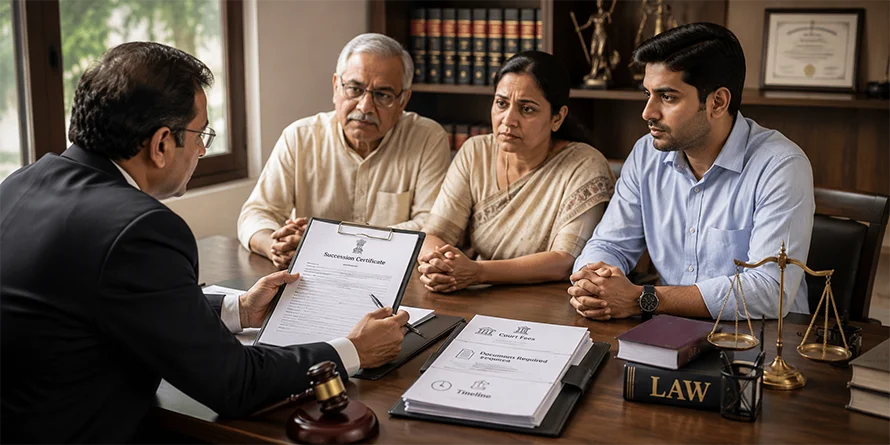
A succession certificate is an essential legal document when settling the debts and securities of a deceased person. If you’re handling estate matters—whether it’s bank balances, investments, or succession certificate for immovable property—you’ll likely need this certificate from court. At OmShakthy Homes, we often guide clients who are resolving estates before they buy plots in Chennai or transfer property. This blog explains the meaning of succession certificate, the procedure for succession certificate, documents required for succession certificate, court fees, and the typical timeline. It also touches on alternatives such as a succession deed or letter of succession.
What is a Succession Certificate?
A succession certificate is a legal document issued by a civil court that authorizes the legal heirs to collect the deceased person’s outstanding debts, securities, and financial assets. It confirms who is entitled to receive these monies and relieves third parties (banks, companies) from liability when they pay the heirs. Note: a succession certificate primarily covers debts and securities, not always immovable property—though banks and financial institutions commonly require it to release funds.
When do you need a Succession Certificate?
- To claim unpaid debts and dues in the deceased’s name (bank deposits, government securities, public provident fund, shares).
- When there is no valid will, or when heirs prefer a court-issued document to avoid disputes.
- To claim life insurance or share certificates when companies request court proof.
If the estate includes immovable property, you may need a succession certificate for property in some cases; however, many states/registrars accept a succession deed or legal heir certificate for property transfer.
Who can Apply for a Succession Certificate?
- Any person who is entitled to the debts or securities of the deceased (legal heir or creditor).
- Multiple heirs can apply jointly or one heir can apply on behalf of others with consent.
- Filing the application for succession certificate is a court process; if the deceased died intestate (without a will), heirs file under the Indian Succession Act, 1925.
Procedure for Succession Certificate: Step by Step
- Prepare the application for succession certificate: The application lists deceased’s details, list of securities/debts, names and relationships of legal heirs, and relief sought.
- File in the appropriate court: File at the District Court or High Court as per jurisdiction (usually where the deceased last resided).
- Serve notice to public and creditors: Courts issue notice to potential claimants and publish in newspapers to invite objections.
- Verification and hearing: Court verifies evidence, hears any objections, and examines the applicant and witnesses.
- Granting the succession certificate from court: If satisfied, the court issues the succession certificate specifying the debts and names of heirs.
Documents required for Succession Certificate
- Death certificate of the deceased (original and copies)
- Application for succession certificate (signed, with details)
- Proof of relationship (birth certificates, family records, Aadhaar, PAN)
- Succession affidavit or indemnity bond (if requested)
- Details and evidence for debts/securities: bank passbooks, loan statements, share certificates, demat statements
- No objection certificates from other heirs (if available)
- ID and address proof of the applicant (Aadhaar, passport, voter ID)
- Court fee payment receipt and any required stamp papers
- Succession deed or family settlement documents, if available
Court Fees and Succession Certificate Cost
- Succession certificate cost varies by state and value of estate; courts typically charge a court fee based on the value of debts/securities involved.
- Many states calculate fees as a percentage or fixed scale—this is often a few hundred to several thousand rupees for typical estates; for large estates, fees rise with value.
- Additional costs: lawyer fees, publication charges for notices in newspapers, stamp duty for any required undertakings, and administrative expenses.
- You can sometimes reduce expenses by applying without a lawyer if the matter is uncontested.
Succession Certificate for Immovable Property — Special Considerations
- A succession certificate primarily covers movable assets (debts and securities). For immovable property, transfer often requires succession deed, probate, or legal heir certificate depending on the state and local registrar’s practice.
- If banks or institutions hold property-linked dues (like post-dated rent cheques or mortgage receipts), a succession certificate for property-related claims may still be necessary.
- To register property in heirs’ names, you may need a succession deed, a probate (for testate cases with a will), or mutation at municipal/tehsildar offices—procedures differ by state.
Succession deed vs. Succession Certificate vs. Letter of Succession
- Succession Certificate: court-issued document for collection of debts and securities.
- Succession Deed: a voluntary document executed by legal heirs to transfer immovable property among themselves; registered and often used to avoid lengthy court processes when heirs agree.
- Letter of succession: informal term sometimes used for a letter from banks or institutions acknowledging heirship; not a substitute for court-issued succession certificate.
Choose the document that suits the asset type and whether heirs are in agreement.
Succession Certificate Online: Is it possible?
- Several states/jurisdictions offer online filing for succession matters, enabling submission of applications, uploading documents, and tracking case status.
- Some courts allow e-filing of civil suits including succession matters; check the local district court portal.
- While initial steps may be online, final verification, publication of notices, and hearings often require court appearances or physical submissions.
Timeline: How long does it take?
Typical timeline ranges from 3 months to over a year, depending on:
- Court backlog and jurisdiction
- Complexity of the estate and number of heirs
- Objections from creditors or disputed claims
- Time taken for publication of notices and responses
Uncontested, straightforward cases can be resolved in a few months; contested cases will take longer.
Practical Tips and Quick Checklist
- Start with an inventory: list all bank accounts, investments, and securities with documentary proof.
- Obtain multiple certified copies of the death certificate.
- Gather relationship proofs and identity documents for all heirs.
- Consider a succession deed if all heirs agree—this often speeds up property transfers.
- Check if e-filing is available on the local court portal to save time.
- Keep communication open among heirs to avoid disputes that delay proceedings.
- Consult a local lawyer for high-value or contested estates; for simple uncontested matters, guided self-filing may be possible.
Summary
- Succession certificate is a court-issued document allowing heirs to collect debts and securities.
- Apply at the appropriate court with death certificate, relation proofs, and supporting documents.
- Costs include court fees (based on estate value), lawyer fees, and publication charges.
- Timeline varies widely; uncontested cases may finish in months, contested ones can take much longer.
- For immovable property, consider succession deed or local transfer procedures in addition to or instead of a succession certificate.
Handling an estate can be emotionally and administratively demanding. If you are planning estate-related transactions or intend to buy plots in Chennai, OmShakthy Homes can connect you with trusted legal advisors familiar with local property transfer practices. For tailored guidance on succession certificate procedures or succession deed alternatives in Tamil Nadu, consult a qualified legal expert to ensure a smooth transfer of assets.